“The weather was clear but very cold. At 10 AM, Mr. Smith and Mr. Riggs visited, and held a discussion in my office with two farmers...”
“Mr. Riggs was my great-grandfather; he was a key member of the Nanjing Safety Zone International Committee back then.” In this February, American youth Chris Hankin came to Nanjing as a student. A month ago, while reading the Terror in Minnie Vautrin's Nanjing, he unexpectedly came across the name of his great-grandfather, Charles Riggs, which revived memories of his youth. Following the narrative clues of Ms. Minnie Vautrin, Chris embarked on his journey of exploration in Nanjing.
“In the very campus where I study, he once protected many people.”

Chris Hankin reading Terror in Minnie Vautrin's Nanjing in campus of Nanjing University
Chris Hankin is a student at The Johns Hopkins University-Nanjing University Center for Chinese and American Studies. During his high school years, he had heard about his great-grandfather's deeds from his family. “My great-grandfather was an American professor at Jinling College, which is the predecessor of Nanjing University. His Chinese name was Lin Charlie, so I chose the Chinese name 'Lin Kui' for myself.”
Chris said his quest began back in 2018. At the time, he was teaching at Northwestern Polytechnical University and took a winter break trip to Nanjing with his parents, during which he first visited the Memorial Hall of the Victims in the Nanjing Massacre by Japanese Invaders. “We visited the 'Nanjing Massacre Historical Exhibition' and were thrilled to see a photograph of my great-grandfather. I later posted a photo of me and my great-grandfather together on WeChat, and many of my students commented, moved by his story. Since then, I have been interested in the history of the Nanjing Massacre and wanted to learn more about his experiences during that time,” said Chris.
Recently, while reading Terror in Minnie Vautrin's Nanjing, Chris repeatedly came across his great-grandfather's name. In a diary entry dated March 28, 1938, Vautrin wrote: “Those of you who have been to the Jinling Auditorium would be surprised to see it now: the south half is stacked with sacks of wheat as high as the stands; the north half, with sacks of rice and flour. Two machines are busy milling wheat in the porch, to later supply the porridge factories or to be sold to refugees. This wheat was 'stolen' for the refugees by Riggs and Thorn over several days or even weeks.”
Only then did Chris realize the touching story associated with the school auditorium he often passed by. “Here, he once protected many people.”
Chris shared his discoveries in Nanjing with his great-aunt in America. “My great-aunt is Charles Riggs' second daughter, born in Nanjing, and is 94 years old this year. She was thrilled and found a letter from my great-grandfather to my great-grandmother dated January 15, 1938, among some old items she kept,” Chris shared. In the letter, his great-grandfather described the atrocities committed by the Japanese army over the “past month,” writing: “A hundred pages would not be enough, nor could any amount of words fully convey the horror and barbaric acts we've witnessed...”
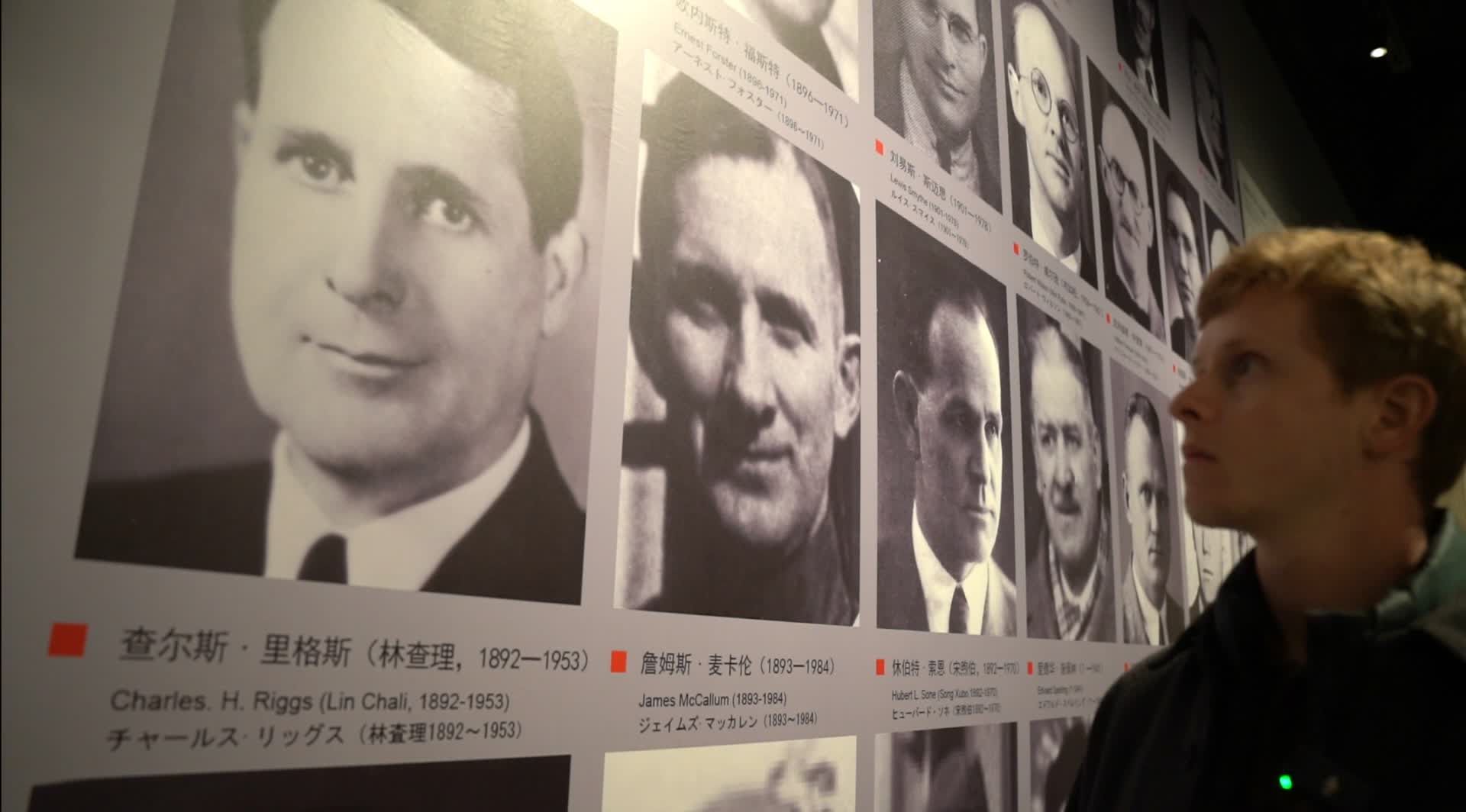
Chris Hankin starring at the photo of Charles H. Riggs, his great-grand parent at Memorial Hall of the Victims in Nanjing Massacre by Japanese Invaders
Chris once again visited the Memorial Hall of the Victims in the Nanjing Massacre by Japanese Invaders. Standing before the statue of Vautrin, he read the words written by John Rabe: “Vautrin was like a mother hen protecting her chicks!” He looked up at his great-grandfather's photo with deep emotion.

Chris Hankin starring at the Statue of Goddess for Peace in the Peace Square of Memorial Hall of the Victims in Nanjing Massacre by Japanese Invaders
“Whether it was Vautrin or my great-grandfather Charles Riggs, all those foreigners who helped the refugees were people who bestowed kindness upon this world, which is incredibly admirable. This is our family's pride,” said Chris.
Encountering Minnie Vautrin, Witnessing the History of the Nanjing Massacre
During the Nanjing Massacre, Ms. Minnie Vautrin, acting principal of Jinling Women’s Arts and Science College, utilized the refugee camp within the college to protect tens of thousands of Chinese women and children from Japanese atrocities. Having read Terror in Minnie Vautrin's Nanjing, Chris Hankin felt compelled to visit the place where Vautrin had worked for 18 years.
“Nanjing Normal University is actually quite close to me. At the entrance of the Suiyuan campus, a student from Nanjing Normal, Liu Chang, told me that it was here that Vautrin repeatedly confronted Japanese soldiers, striving to drive them away. Vautrin also arranged for my great-grandfather and other foreign men to stay near the entrance of Jinling Women’s College at night to protect the refugees there,” Chris said.
In early December, on a sunny and warm day with golden ginkgo leaves fluttering in the wind, Chris visited the Suiyuan campus of Nanjing Normal University (formerly the site of Jinling Women’s College). He recalled that during the winter of 1937, Vautrin often wrote about “good weather” in her diary. Before the fall of Nanjing, rainy days were considered good because they prevented Japanese planes from bombing; after the fall, Vautrin always hoped for sunny days so that those sleeping in the corridors wouldn't freeze.
“Terror in Minnie Vautrin's Nanjing mentions that on the afternoon of December 17, 1937, a large number of female refugees flooded into the campus. Unable to accommodate everyone, Vautrin contacted Jinling University to secure a dormitory to house women and children. Fearing Japanese interference along the way, Vautrin always led the group of women,” Chris explained.
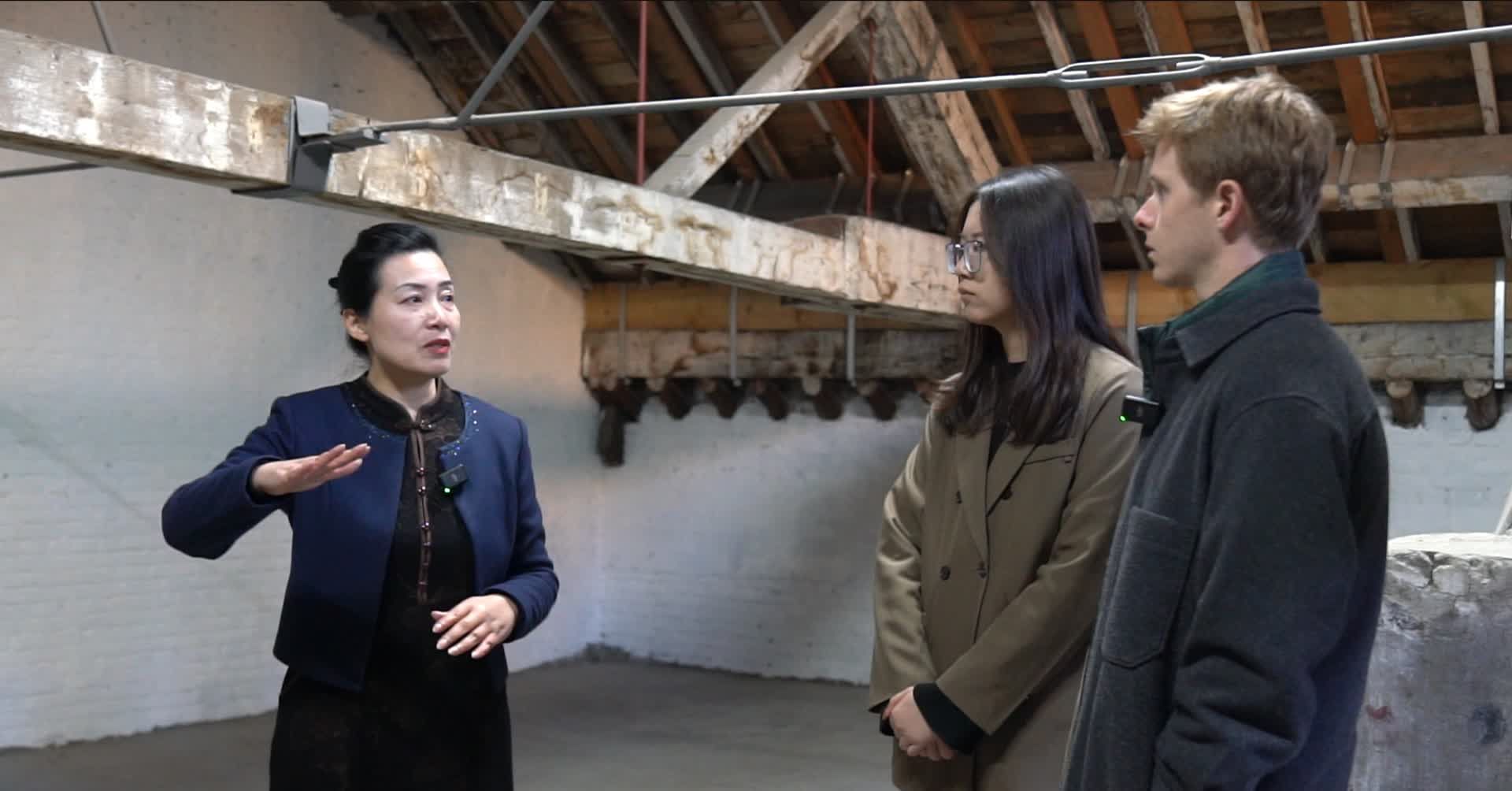
Chris Hankin visiting the attic of building 100 in Nanjing Normal University
Inside building 100 on the Suiyuan campus, Chris, guided by Yang Suping, the vice dean of Nanjing Normal University's Jinling Women’s College, visited the attic and basement. Opening the door to the attic brought history rushing forth. “During the Nanjing Massacre, young girls, fearful of being captured by Japanese soldiers, had to hide in the attic and basement, trembling at every footstep,” Yang said, her voice choked with emotion. “The tea rooms on the first floor of building 100, once spots for schoolgirls to date, were filled with refugees sleeping on mats after the fall of Nanjing. Vautrin often sat in her nearby office, keeping an eye on the students,” Yang shared.
Yang told Chris that the old humanities building, now building 300, was also filled with people back then, and babies were even born under the stairs. “I can hardly imagine a new life beginning in such cramped conditions,” said Chris.
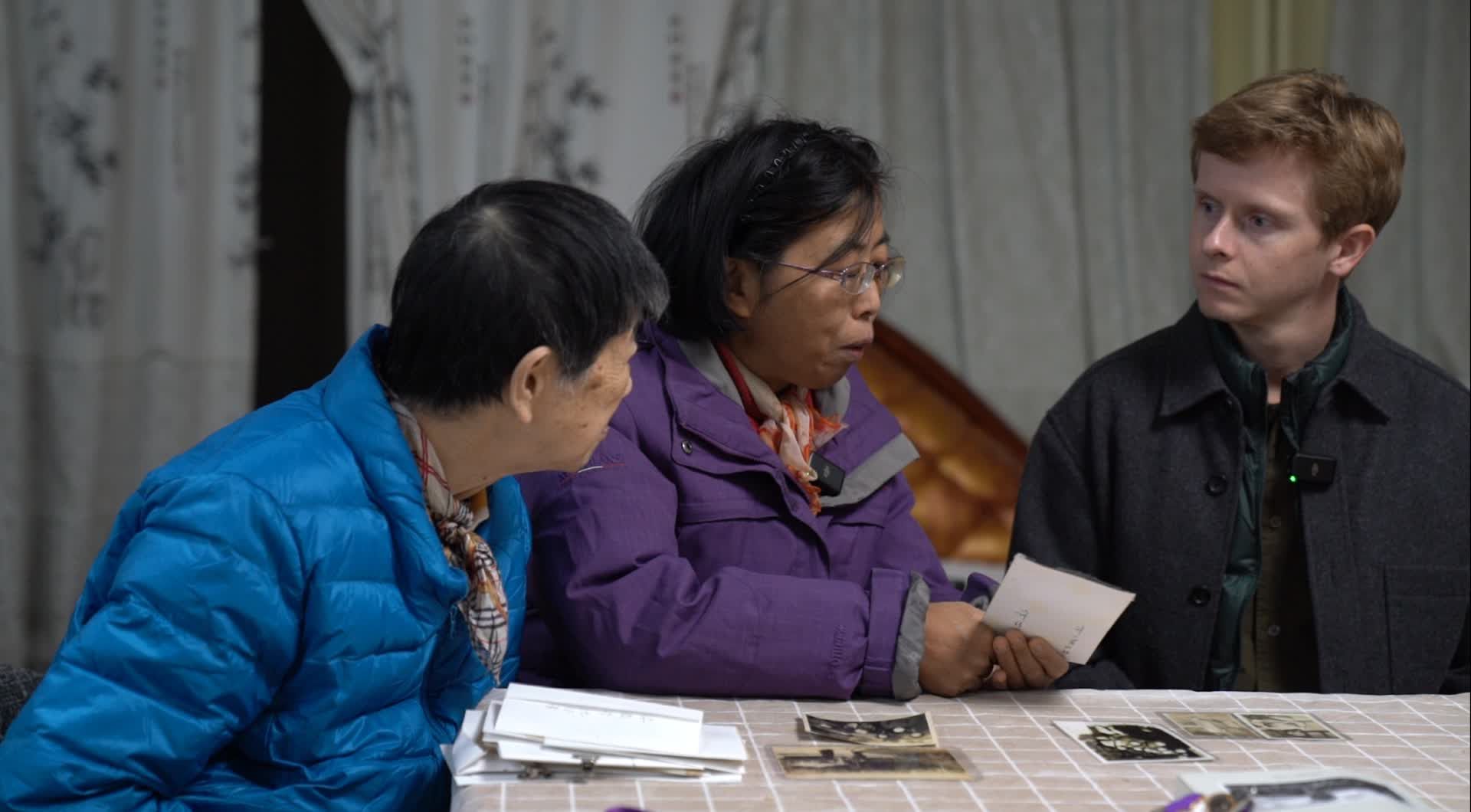
Chris Hankin visiting the decendents of Xu Chuanyin
The stories from that time continue to deeply move Chris. To learn more, he visited the descendants of Xu Chuanyin, also mentioned in the Terror in Minnie Vautrin's Nanjing. Xu Chuanyin's granddaughter, Zhang Qing, told Chris that her grandmother had overseen the housing arrangements for refugees in the Nanjing Safety Zone, and Charles Riggs, his great-grandfather, had been the housing commissioner for the Nanjing Safety Zone. “They must have known each other,” said Zhang Qing.
As he was leaving, Zhang Qing's mother and Xu Chuanyin's granddaughter, Xu Yimei, gave Chris a lucky pouch she had woven herself. Chris immediately expressed his intention to send one to his family in America.
“This City Has Never Ceased to Be Grateful to the International Friends Who Protected Them”
“In Nanjing, history is still alive. The people here are deeply moved by Minnie Vautrin; just mentioning her name brings tears to their eyes,” Chris Hankin conveyed during a video call with Cindy Vautrin, Minnie Vautrin's great-niece in the United States on December 6, telling her about the people of Nanjing's remembrance and gratitude towards Vautrin.
“If you read her letters, her diaries, and everything else, you'll realize that China really was her home. It was where she felt most comfortable,” Cindy Vautrin replied.
In December 2002, a bronze statue of Minnie Vautrin was erected at Nanjing Normal University, bringing Vautrin back to the campus she dearly loved. Standing in front of Vautrin's statue, Chris softly read the words on the monument: “Eternal Jinling, Jinling eternal!” Liu Chang told him that just days ago, a group of people from Nanjing had set out from this spot, passing through the former residence of John Rabe, Drum Tower Hospital, and the old site of the Nanjing Safety Zone International Committee, in a walking event to remember and honor the more than twenty international heroes who helped the people of Nanjing during their darkest times. “This 'Gratitude·Nanjing Safety Zone' international peace walking event has been held seven times since 2016,” Liu Chang explained.
Chris also visited Professor Zhang Lianhong, the director of the Nanjing Massacre Research Center at Nanjing Normal University. “Professor Zhang is very familiar with my great-grandfather's story. He told me that just before the Nanjing Massacre, my great-grandfather was mainly responsible for arranging housing for refugees, and during the massacre, he was more involved in the procurement and transportation of food for the refugees,” Chris said. “So many years have passed, and yet there are still scholars who want to learn more about their stories and study their impact, which is very touching.”
During his visit, Chris deeply felt that for Minnie Vautrin, his great-grandfather, and all the international friends who protected Chinese refugees, the people of Nanjing have never stopped being grateful. The names of those international friends are often mentioned by the people of Nanjing, and the brutal history of those times is becoming more widely known internationally. Chris said he wants to tell Minnie Vautrin and his great-grandfather that today's Nanjing is beautiful, and China has undergone tremendous changes.
“I will also continue my search and storytelling,” Chris concluded.