This month, the Hopkins-Nanjing Center for Chinese and American Studies (subsequently “HNC”) held a lunchtime activity in the student lounge: “The Friendship Formula: A Grad Student’s Guide to Building Deeper Connections”. The activity was jointly hosted by Sherry Zhang, Coordinator for Gender Violence Prevention, Education, and Response at Johns Hopkins in Baltimore, and Siyue Wu of the Nanjing University Office of Mental Health Services. Over 20 student participants actively participated in the discussion, whose theme surrounded developing stronger interpersonal relationships.
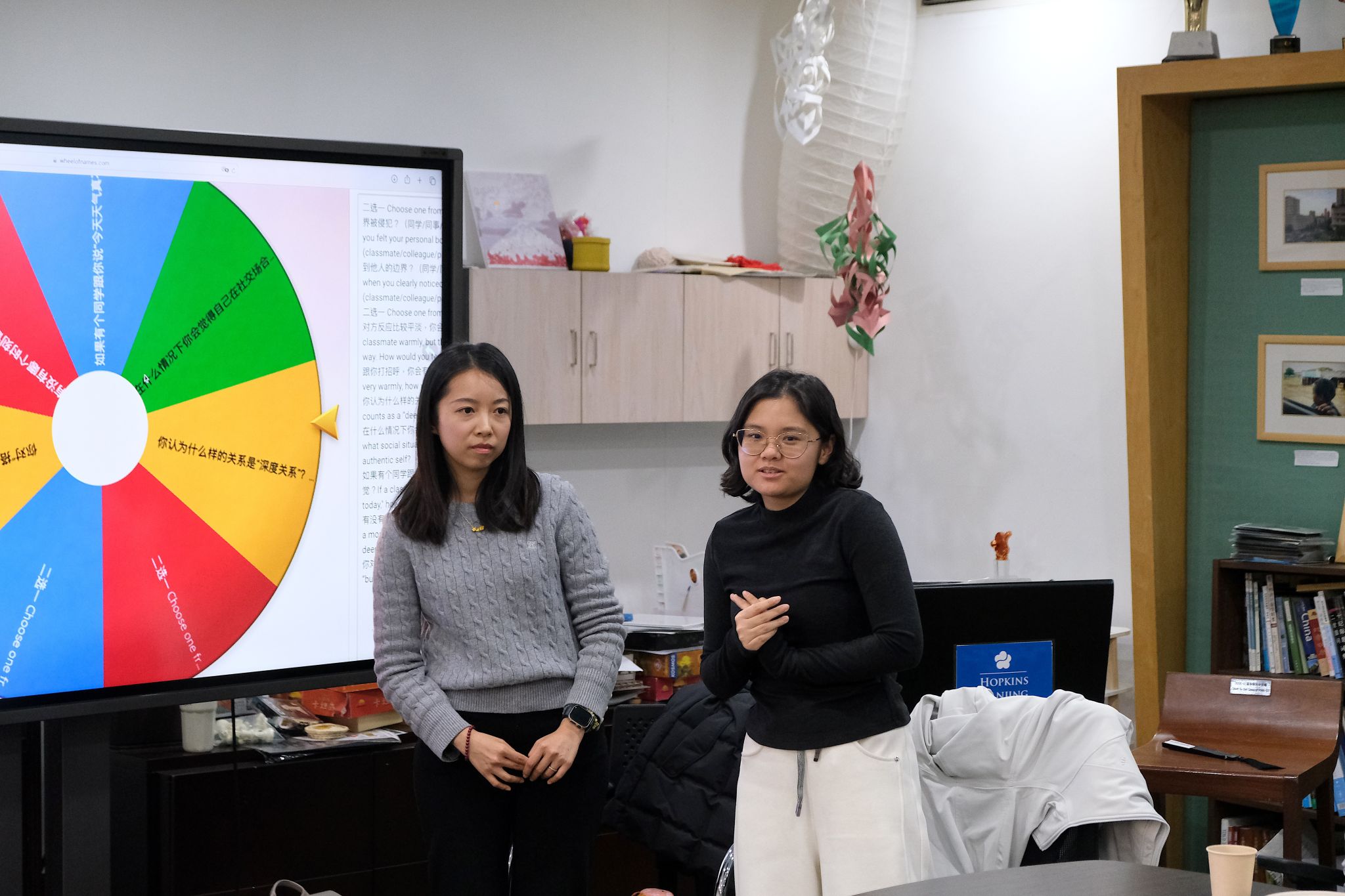
Hosts Siyue Wu (left) and Sherry Zhang (right)
1. Warm-up activity: Ice-breaker and response
The program opened with an ice-breaking game known as “Ji Gu Chuan Hua” (Literally, “beat the drum and pass the flower”). The game began with the activity leader playing a drum beat as students passed a flower around the circle. When the drumming stopped, the student holding the flower would answer a pre-determined question. As game play progressed, the drumbeat would pause after shorter increments of time, increasing student excitement and engagement while creating a relaxed environment for all.

The game in progress
2. The central topic: Interpersonal relationships and personal growth
The central theme of the lunch activity focused on interpersonal relationships and personal growth, particularly in the context of the HNC. Each participant spoke up, opened their hearts, and willingly shared their personal experiences and perceptions.
The activity began with a discussion on strategies for building interpersonal connections in different contexts, and students brought up practical experiences with communication and exchange in contexts such as the workplace and with a romantic partner. Participants further discussed the influence of cultural differences on ways of behaving in context, as well as ways to balance individual identity with adaptation and integration in a cross-cultural environment like the HNC.
Next, the discussion moved on to considering “using others as a mirror to recognize the self” as a method for growth. This section focused on managing conflicts within social situations and practical strategies for building cross-cultural relationships. By specifically addressing the confusion brought about by “Da Zi” culture (“companion culture”), participants shared how to establish healthy and balanced relationships, especially how to realize shared growth through mutual support. The discussion provided helpful direction particularly suitable for the graduate student experience.
Lastly, the conversation turned to discussing one’s individual attitude towards life, and participants shared their insights on facing loneliness, stress, and other common troubles. Regarding life’s conflicts and challenges, students discussed actively seeking to have a problem-solving mindset, conveying the importance of a life wisdom that maintains a positive mentality in a state of dynamic equilibrium.
3. At the scene: Honest engagement and mutual understanding
The entire luncheon activity was steeped in an atmosphere of openness and sincerity as participants enthusiastically shared their lived experiences and troubles, gaining insight and understanding through the meeting of varied perspectives. Students came away from the activity with a clearer sense of how to build healthy, positive interpersonal relationships, acquiring a new layer of valuable experience to assist with future growth.
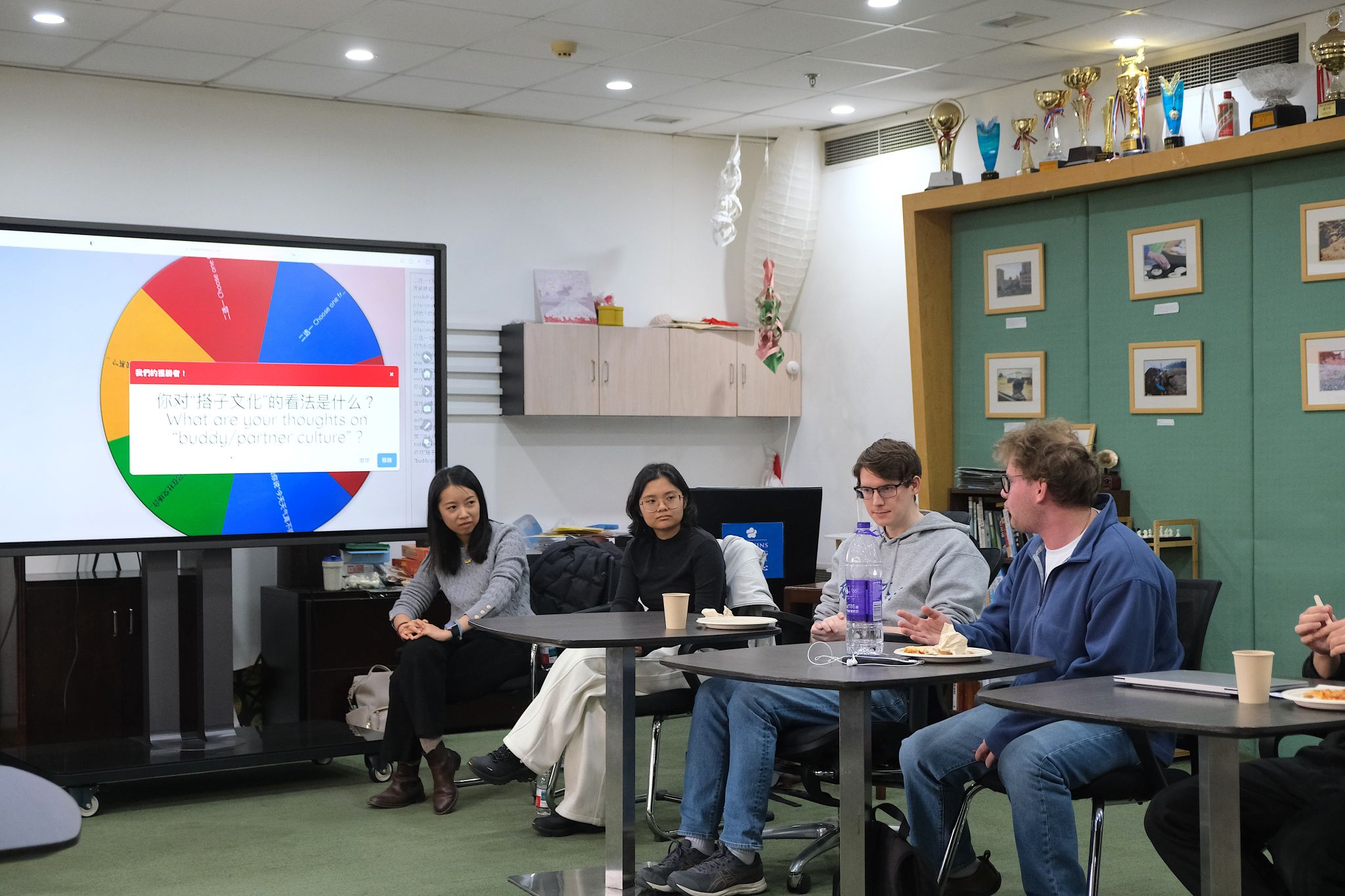
Sharing and exchange