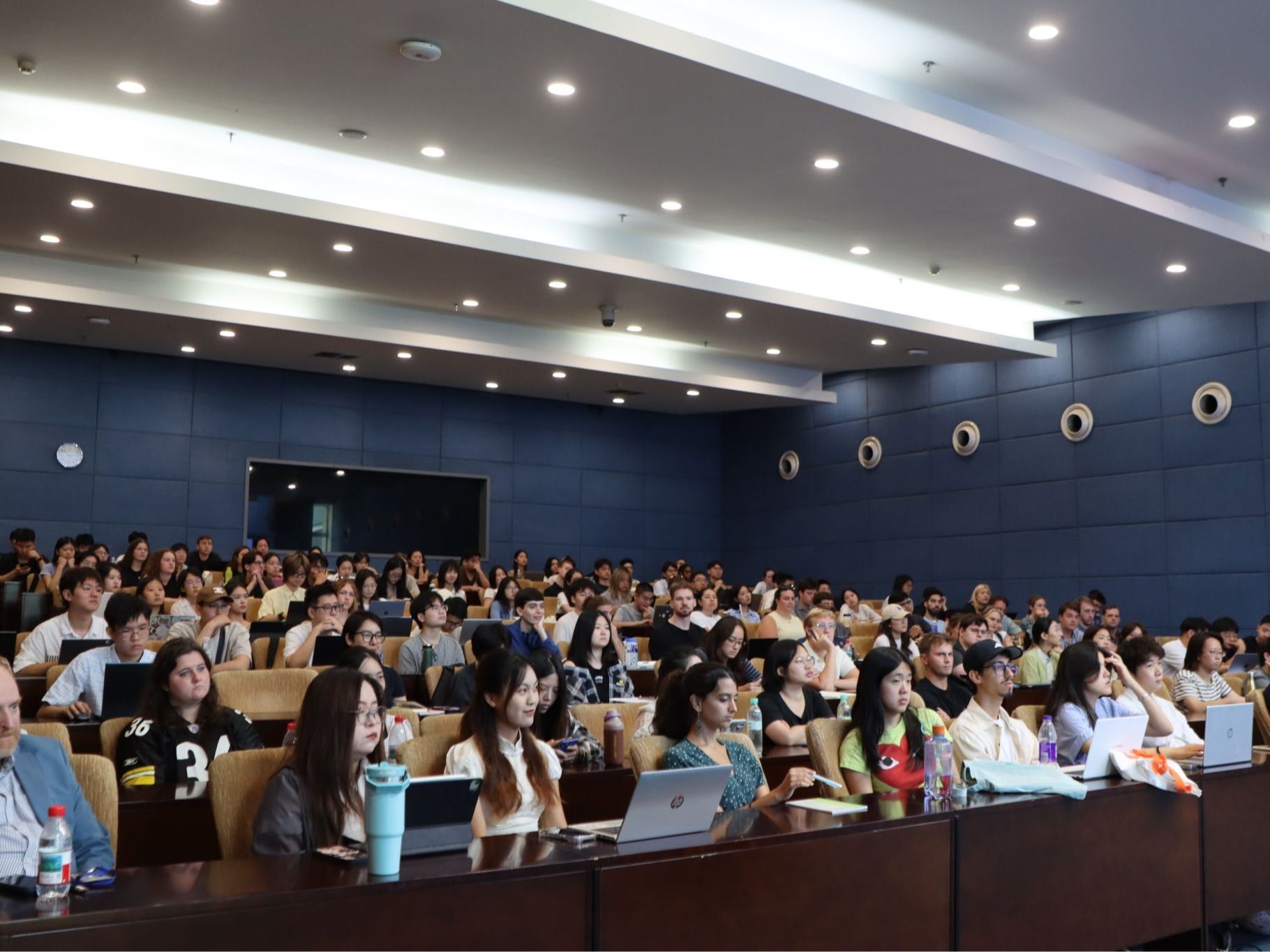
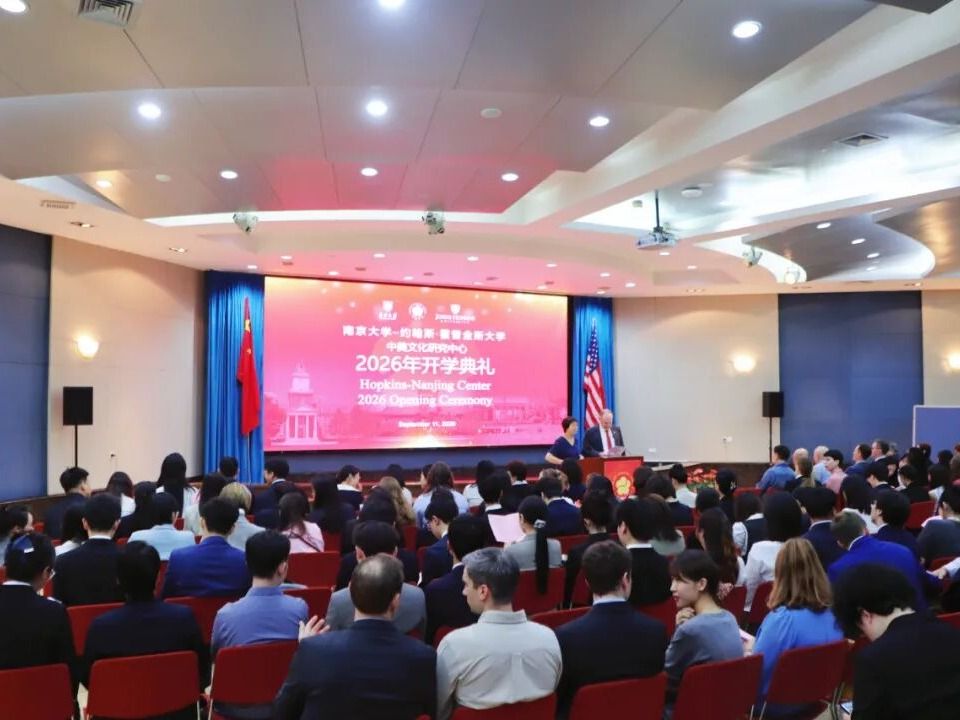
On the afternoon of June 20, 2026, the 40th anniversary celebration of the Hopkins–Nanjing Center (HNC), jointly established by Nanjing University and Johns Hopkins University, was held at the Great Hall on Nanjing University’s Gulou Campus. More than 700 guests gathered to celebrate this milestone. The ceremony was co-hosted by Li Xiaorong, Chinese Co-Director of the HNC, and Adam K. Webb, U.S. Co-Director of the HNC.

The 40th anniversary celebration.
Distinguished guests attending the celebration included Ronald J. Daniels, President of Johns Hopkins University; James B. Steinberg, Dean of the Johns Hopkins School of Advanced International Studies (SAIS) and former U.S. Deputy Secretary of State; Jill McGovern, wife of former Johns Hopkins University President Steven Muller; John Lipsky, Chair of the HNC Board of Trustees on the Johns Hopkins side; and representatives of the U.S. Embassy and consulates in China.
The keynote speakers representing the United States and China were former U.S. Senator Benjamin L. Cardin and Shen Xin, Vice President of the Chinese People’s Association for Friendship with Foreign Countries. Ren Youqun, Vice Minister of Education of China, addressed the event via video, alongside representatives of relevant government departments in Jiangsu Province and Nanjing. Other attendees included Kuang Rongrong, son of Kuang Yaming, the former President of Nanjing University who helped establish the Center; Tan Zhemin, President of Nanjing University and academician of the Chinese Academy of Sciences; former Nanjing University Party Committee Secretaries Hong Yinxing and Hu Jinbo; Yang Zhong, former Executive Deputy Secretary of the university’s Party Committee; Chen Yunsong, Deputy Secretary of the university’s Party Committee; Su Wenbin, Member of the university’s Party Committee and Vice President; other university leaders; and representatives of peer institutions.

President of Johns Hopkins University Ronald J. Daniels delivers welcoming remarks
Speaking on behalf of Johns Hopkins University, President Ronald J. Daniels extended his warm congratulations on the HNC’s 40th anniversary. He noted that celebrating the Center’s milestone was particularly meaningful as Johns Hopkins University also commemorates the 150th anniversary of its founding.
As an important part of Johns Hopkins University’s educational tradition and institutional history, the HNC was established during a pivotal period in the development of China–U.S. relations. Daniels emphasized that over the past four decades, despite changes in the international landscape and bilateral relations, the Center has remained committed to openness, inclusivity, and mutual learning. It has provided students from around the world with a platform for learning from one another and growing together, educating generations of professionals with global perspectives and cross-cultural communication skills. The HNC has become an important bridge for mutual understanding and people-to-people exchanges between China and the United States.
Looking ahead, Daniels observed that in confronting shared challenges such as climate change, technological transformation, and shifts in the global order, the international community needs open dialogue and practical cooperation more than ever. He expressed the hope that the HNC would remain true to its founding mission and continue to uphold academic rigor, openness, inclusivity, and intellectual curiosity while promoting exchanges among different cultures and ideas.
Johns Hopkins University, he affirmed, would continue to deepen its partnership with Nanjing University, strengthen bilateral cooperation, and support the HNC’s continued development. Together, the two universities would inject new momentum into the education of young people with global perspectives and the advancement of educational cooperation and mutual understanding between civilizations in China and the United States.

President of Nanjing University Tan Zhemin delivers welcoming remarks
Speaking on behalf of Nanjing University, President Tan Zhemin reviewed the history of the HNC’s establishment. He noted that the Center was the first joint educational institution established through international higher education cooperation in China following the launch of reform and opening-up, and has since become an important model of educational exchange and cooperation between China and the United States.
Over the past 40 years, the HNC has remained committed to fostering mutual understanding among civilizations and promoting cross-cultural exchange. It has actively advanced educational cooperation and people-to-people ties between the two countries, pioneering what has become known as the “Nanjing–Hopkins model” of deep cooperation between Chinese and American universities.
As the Center enters a new chapter in its development, Tan outlined three expectations for its future.
First, he called on the HNC to remain true to its founding mission, continue serving as a platform for cross-cultural exchange, and further promote dialogue and mutual understanding among civilizations.
Second, he encouraged the Center to deepen cooperation and exchanges by expanding its partnerships with its two parent universities and institutions across China and the United States, thereby advancing people-to-people diplomacy and international higher education cooperation.
Third, he emphasized the importance of nurturing future leaders by improving the Center’s distinctive educational model, which transcends languages, cultures, academic disciplines, and national borders, and cultivating more outstanding leaders with international perspectives, professional expertise, and a strong sense of responsibility.
Tan also noted that Nanjing University and Johns Hopkins University signed a new five-year cooperation agreement at the end of the previous year, laying a solid foundation for the Center’s future development. The HNC’s 40-year history, he said, represents both a vivid example of educational cooperation and people-to-people exchange between China and the United States and a significant achievement in fostering mutual understanding among civilizations.
Nanjing University will continue to provide full support for the Center’s development and work hand in hand with Johns Hopkins University and the HNC’s extensive alumni community to advance the Center into its next stage of growth.

Vice Minister of Education of China Ren Youqun delivers a video address
In his video address, Ren Youqun, Vice Minister of Education of China, extended warm congratulations on behalf of the Ministry of Education to all faculty, staff, and students of the HNC, as well as its alumni in China and abroad. He also conveyed sincere greetings and heartfelt thanks to colleagues at both universities and to people from all sectors of society who care about and support educational exchanges between China and the United States.
Ren noted that the HNC is an innovative initiative through which leading universities in China and the United States jointly establish a high-level platform for exchange and cultivate outstanding international talent. It has pioneered practices in Sino-foreign cooperative education. The HNC has consistently upheld the philosophy of “studying together, living together, growing together, and developing together.” It has educated nearly 4,000 outstanding individuals from more than 40 countries who are familiar with international politics and bilateral and multilateral affairs. The Center has become one of the most vibrant links and most enduring models of cooperation in education between the two countries, demonstrating the irreplaceable human dimension of China–U.S. relations. The HNC’s 40 years of practice have fully demonstrated that only through sustained exchange and mutual learning can the two sides pool their strengths and work together to address global challenges.
Looking to the present and the future, Ren expressed the hope that Nanjing University and Johns Hopkins University would make full use of their distinctive advantages as pioneers in China–U.S. educational cooperation and take the 40th anniversary as a new starting point to jointly establish a new benchmark for cooperation between Chinese and American universities in the new era.
He encouraged the HNC to build consensus through academic dialogue and make effective use of its role as a platform for dialogue and a think tank; to strengthen its foundations through talent development, carry forward the foresight and sense of responsibility of earlier generations of Chinese and American strategists, and cultivate more globally minded individuals who understand both countries and their national conditions; and to lead the way forward through innovative cooperation by expanding its models of collaboration and improving their quality and effectiveness. Through high-level cooperation, the Center should help chart new paths for the development of higher education and jointly shape the future of education.
Ren emphasized that educational cooperation between China and the United States concerns not only the development of the two countries themselves, but also global prospects and the shared destiny of humanity. Both sides should continue to support the development of the HNC, help their universities deepen cooperation, and promote the steady and sustained development of people-to-people exchanges between China and the United States. In doing so, they can help strengthen the foundations of friendship between the two countries and contribute to global economic and social development.

Former U.S. Senator Benjamin L. Cardin delivers an address
During the keynote address session, U.S. guest Benjamin L. Cardin extended warm congratulations on the HNC’s 40th anniversary and recognized the important role the Center has long played in promoting educational cooperation and people-to-people exchanges between China and the United States.
He expressed the hope that HNC students and alumni would continue to uphold a spirit of openness and inclusiveness, seek common ground while respecting differences, deepen understanding through dialogue and exchange, and build consensus through practical cooperation. He encouraged them to contribute their knowledge and efforts to the healthy and stable development of China–U.S. relations and to world peace and prosperity.

Shen Xin delivers an address
Shen Xin, Vice President of the Chinese People’s Association for Friendship with Foreign Countries, extended the Association’s congratulations to the HNC.
Shen emphasized that, as one of the earliest and longest-running cooperative institutions between Chinese and American universities established after China’s reform and opening-up, and one with far-reaching influence, the HNC has drawn on the strengths of its two prestigious parent universities over the past 40 years while remaining true to its founding mission of transcending languages, cultures, academic disciplines, and national borders. It has devoted sustained efforts to people-to-people exchanges between China and the United States. The Center has not only educated large numbers of highly qualified individuals with global perspectives who have gone on to work across a wide range of fields, but has also continued to organize academic seminars, cultural dialogues, and youth exchange visits. Despite changes in the international landscape and fluctuations in China–U.S. relations, it has consistently served as a builder of friendship between the two countries, a promoter of mutual learning among civilizations, and a bridge facilitating mutual understanding between their peoples. It has become an outstanding model of people-to-people exchange and higher education cooperation between China and the United States.
Referring to the 55th anniversary of China–U.S. “Ping-Pong Diplomacy” and the consensus reached at a recent meeting between the two countries’ leaders, Shen observed that, as the world undergoes profound changes unseen in a century at an accelerating pace, exchange and mutual learning serve as a stabilizing anchor for China–U.S. relations, a direct route to mutual understanding, and a means of sowing the seeds of friendship among young people.
Shen expressed the hope that, with its 40th anniversary as a new starting point, the HNC would continue to serve as a benchmark for China–U.S. higher education cooperation, a window for people-to-people exchanges, and a nurturing ground for young people. He encouraged the Center to keep innovating in its approaches to exchange, broaden its areas of cooperation, and bring young people together. By remaining true to its founding mission of promoting mutual learning among civilizations, the HNC should continue to build bridges of communication between China and the United States in a complex and changing world. He expressed the hope that the Center would contribute further to the healthy and stable development of China–U.S. relations, exchanges and mutual learning among civilizations around the world, and the building of a community with a shared future for humanity.
He concluded by wishing that people-to-people exchanges between China and the United States would continue to thrive and that friendship between the two peoples would be passed down from generation to generation.

U.S. Alumni Representative Brian Wong delivers an address
Brian Wong, the U.S. alumni representative, is the founder of RADII and formerly served as Vice President of the Alibaba Group. He shared his experience as a student and noted that the HNC’s distinctive value extends far beyond language learning and academic research. It is a community where young people from different countries and cultural backgrounds study together, live together, and engage in in-depth exchanges.
The cross-cultural friendships and mutual understanding he developed at the Center profoundly influenced his subsequent career choices and life path. He emphasized that promoting exchanges between China and the United States is not solely the responsibility of governments and professional institutions. Everyone can contribute by sharing authentic stories, engaging in cultural exchanges, and fostering mutual understanding.
The HNC’s most valuable feature, he noted, is that it enables students to become part of one another’s daily lives and understand different cultures through shared learning and living. Such experiences cannot be replaced by knowledge gained from books alone.
As a third-generation Chinese American, Wong believes that both Chinese and American cultures have shaped his sense of identity. Although China–U.S. relations currently face many challenges, he remains firmly convinced that people-to-people exchanges are an important bridge for deepening understanding and dispelling misunderstandings.
Whether working in business, public policy institutions, or international exchange programs, he has consistently sought to build bridges of communication and promote dialogue and understanding between different cultures.
Wong encouraged young students to uphold the principle of integrating knowledge with action, actively participate in cross-cultural exchanges and cooperation, and continue working to deepen mutual understanding between China and the United States. He expressed his belief that the younger generations educated at the HNC would become a key force connecting the two countries and bridging their differences.

Chinese Alumni Representative Zhang Weiguo delivers an address
Zhang Weiguo, the Chinese alumni representative, is the founder of Synutra Pure, Ltd. He noted that the HNC’s 40th anniversary is not only an important milestone in the Center’s development, but also a vivid testament to the long-term development of educational exchanges and people-to-people cooperation between China and the United States.
For 40 years, the HNC has maintained its presence on both sides of the Pacific and developed into a distinctive and enduring platform for cross-cultural exchange between China and the United States, reflecting the development and changes in bilateral relations.
Reflecting on the history of engagement between the two countries over the past several decades, Zhang observed that although China–U.S. relations have experienced ups and downs at different stages, educational exchanges and people-to-people interactions have remained vigorous. The HNC’s continued development over four decades fully demonstrates that promoting mutual understanding and strengthening exchanges and cooperation remain shared aspirations of the peoples of both countries. It also reflects the deep and enduring momentum behind people-to-people exchanges between China and the United States.
Zhang believed that the key to the HNC’s sustained vitality lies in its continued commitment to education and mutual learning among civilizations, as well as its promotion of openness, inclusiveness, rational thinking, and the pursuit of knowledge. Regardless of changes in the external environment, the Center’s commitment to science, art, nature, and the value of education remains an important force for dialogue between different cultures and for deepening mutual understanding.
The Chinese and U.S. Co-Directors of the HNC welcomed the leaders and distinguished guests, alumni, and friends from all sectors of society attending the celebration on behalf of the Center. They also expressed their heartfelt gratitude to all those who have cared about and supported the Center’s development over the years.

Chinese Co-Director of the HNC Li Xiaorong delivers an address
In her opening remarks, Li Xiaorong, Chinese Co-Director of the HNC, noted that the Center’s most valuable asset lies not only in classroom teaching and academic research, but also in the ongoing exchanges and dialogue that take place in everyday study and life.
Drawing on her own experience working at the Center, she observed that faculty members and students from different cultural backgrounds often interpret the same issue in strikingly different ways. It is through repeated exchanges of ideas and perspectives that people learn to see the world from new angles and come to understand one another better.
She noted that young people from around the world come to the Center to study languages, explore cultural differences, and discuss public issues. In classrooms and around dining tables, they build friendships and understanding that transcend national borders. These experiences equip them with the ability to bridge differences and communicate across cultures.
Li stated that over the past 40 years, the HNC has consistently served as an important platform for exchange and mutual learning among different civilizations. Its commitment to openness, inclusiveness, and mutual respect in education has never changed.
She expressed the hope that the Center would continue to carry forward the foresight and founding ideals of the leaders who established the partnership between the two universities, uphold the community spirit shaped by generations of faculty, students, and alumni, and play a more active role in promoting cross-cultural understanding and people-to-people exchanges between China and the United States.

U.S. Co-Director of the HNC Adam K. Webb delivers closing remarks
In his closing remarks, Adam K. Webb, U.S. Co-Director of the HNC, reviewed the Center’s development over the ten years he had served as its director and expressed his gratitude to the faculty, staff, students, alumni, and people from all sectors of society who have long supported its development.
He noted that since 2016, the HNC has faced multiple challenges arising from changes in the international landscape and fluctuations in China–U.S. relations. Throughout this period, the Center has remained committed to openness and cooperation, actively carrying out teaching, research, and exchange activities and demonstrating strong cohesion and resilience.
Whether through the introduction of online teaching or the continued advancement of academic exchanges and practical programs connecting Nanjing in China, Washington in the United States, and Bologna in Italy, the HNC has maintained its vigorous development and vitality.
For 40 years, the HNC has consistently upheld its educational mission of promoting cross-cultural understanding and academic exchange, creating opportunities for students from different countries and regions to study together, live together, and engage in in-depth exchanges. Amid a changing international environment, the Center continues to uphold openness, inclusiveness, exchange, and mutual learning, encouraging students to approach different cultures and perspectives with an open mind and to deepen understanding and friendship through dialogue.

Guests gather for a group photograph
For four decades, the HNC has weathered challenges and remained firmly rooted in the strong partnership between Nanjing University and Johns Hopkins University. Through cross-cultural education and exchanges between China and the United States, it has written a vivid chapter in people-to-people cooperation between the two countries and educated generations of individuals with global perspectives and cross-cultural communication skills.
Standing at a new historical starting point, the HNC will continue to draw on the strengths of both universities, deepen people-to-people exchanges and cooperation between China and the United States, and cultivate more professionals in cross-cultural exchange, contributing to greater mutual understanding between the peoples of the two countries.
The celebration concluded amid warm applause. Yet the HNC’s next journey is already beginning, carrying forward the experience and aspirations accumulated over the past 40 years as it sets out on a new chapter.
HNC 40th Anniversary Celebration Recap