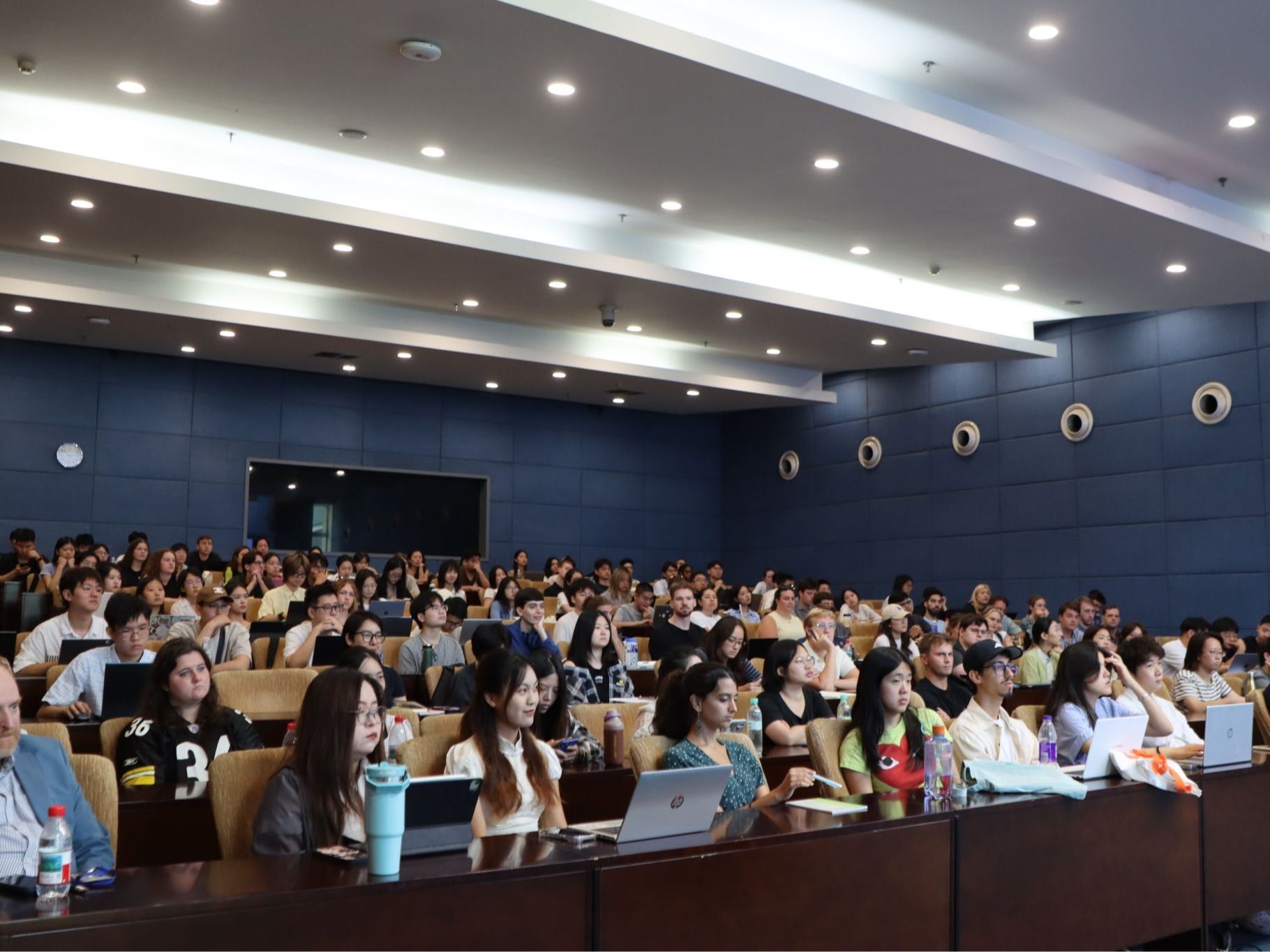
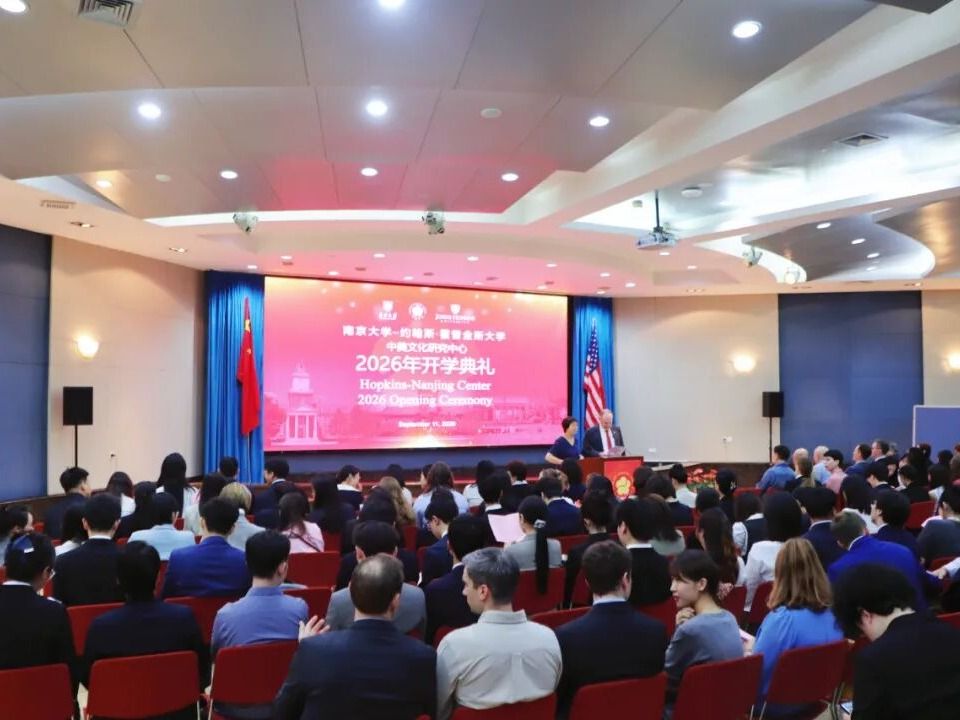
On June 21, 2026, as part of the 40th anniversary celebrations of the Hopkins–Nanjing Center (HNC), the Alumni Sharing Forum was held at the Kuang Yaming Lecture Hall at Nanjing University. Ten alumni from diverse professional backgrounds engaged in in-depth discussions on topics including changes in U.S.–China relations, industry trends, the impact of AI technology, and professional development. They shared their insights and practical experiences with HNC students, faculty, and alumni returning to campus.

The Alumni Sharing Forum
Session I
The first session was moderated by Li Tong, Strategy Manager at Accenture and a member of the 2000–2001 Certificate Class. Four speakers joined the discussion: Amy Celico, Executive Director of the Schwarzman Scholars program and CEO of the Schwarzman Education Foundation, who attended the 1993–1994 Certificate Class; He Jun, Founder and CEO of Gridsum Intelligence Technology and Vice President of TCL, who attended the 1999–2000 Certificate Class; Travis Tanner, a member of the 2001–2002 Certificate Class; and Zhao Xiaoping, Director of International Cooperation at the Center for International Economic and Technological Cooperation of the Ministry of Industry and Information Technology, who also attended the 2001–2002 Certificate Class. Drawing on their professional experiences, the speakers shared valuable reflections on how changes in U.S.–China relations have affected their career paths.

Speakers at Session I
At the beginning of the session, moderator Li Tong introduced the four speakers’ professional backgrounds, noting that their career development had been closely linked to periods of stability in U.S.–China relations. He then posed the central question: How has uncertainty in U.S.–China relations affected their day-to-day work and personal development?

Moderator Li Tong
Amy Celico recalled her time at the HNC in 1993–1994, when U.S.–China relations were also facing challenges. She explained that the strong connections she formed with Chinese and American faculty members and fellow students taught her not to let political disagreements shape her research on China or her understanding of bilateral relations, even when the two governments were deeply divided. “That experience continues to guide me today,” she said. “U.S.–China relations are always changing, but they do not have to define everything.” She noted in particular that trade and economic relations had become a focal point of competition between the two countries over the past six years. This shift prompted her to leave the consulting industry and join the Schwarzman Scholars program, where she hopes to continue fostering mutual understanding across countries by working with younger generations.

Amy Celico
He Jun examined the impact of changing U.S.–China relations on his daily work. Looking back on his 25-year career, he described three stages: during the first decade, he developed China market strategies and established joint ventures for multinational companies; during the second, as Chinese companies rose to prominence, he shifted to helping Chinese companies expand overseas; and over the past two to three years, technology competition between China and the United States has created complex challenges for professionals in fields such as semiconductors and AI, particularly amid efforts toward “decoupling.” He emphasized, however, that challenges also create opportunities. “Restrictions on sharing AI technology between China and the United States have, in fact, created room for innovation in domestic AI applications.” He encouraged current HNC students to draw on the perspectives and skills they had developed at the Center to find opportunities amid change.

He Jun
Travis Tanner reflected on his years at the HNC as an alumnus marking the 25th anniversary of his graduation. He recalled fond memories of living off campus with his wife and children, making pizza with classmates, and baking cakes together. “These relationships can have a lasting impact that changes the course of one’s life,” he said. Drawing on his own career, he explained that China had remained a constant focus throughout his professional life. Regarding U.S.–China relations, he identified the sense of upward momentum as the biggest difference between today and 25 years ago. In the past, the benefits of bilateral engagement were more widely shared; today, the range of those benefiting has narrowed considerably, reflecting the realities of competition between the two countries. He observed that American business executives who succeed in China today are invariably those who develop a deep understanding of the country’s complexities. “That is precisely one of the core skills we learned at the Center,” he said.

Travis Tanner
Zhao Xiaoping began by recalling the distinctive academic and personal experiences he had during his year at the HNC, which forged a lasting connection between him and U.S.–China affairs. After graduating, he worked for an American consulting firm and a U.S. mining safety equipment company, experiencing a golden era for American businesses operating in China. Working alongside American alumni and discussing projects with them, he helped facilitate numerous industrial collaborations between the two countries, particularly in mining safety equipment. After eight years at American companies, he entered government service and helped bring various local cooperation projects involving U.S.-funded companies to fruition. He now works on international industrial cooperation at the Ministry of Industry and Information Technology, where U.S.–China economic and trade ties and exchanges remain an important part of his daily work. With opportunities and challenges coexisting in the current bilateral relationship, he emphasized the growing importance of the HNC and the distinctive role its graduates can play.

Zhao Xiaoping
Session II
The second session was moderated by Tan Yang Long, a member of the 2022–2023 Certificate Class. Four speakers shared their experiences and perspectives across education, law, consulting, and public service: Zilan Xu, Managing Director of Ankai Rui Consulting Group and former Vice President of the U.S.-China Business Council, who attended the 2012–2013 Certificate Class; Brantley Turner, Head of Dwight School Hanoi and a member of the Board of Trustees of Shanghai Qibao Dwight High School, who attended the 1999–2000 Certificate Class; Matt Ferchen, Program Officer at the Ford Foundation’s Beijing Office, who attended the 2000–2001 Certificate Class; and Mu He, a partner at Fangda Partners and a member of the 2012–2015 Master’s Class.

Speakers at Session II
Alumni in the audience engaged with the speakers on topics including cross-industry collaboration in AI and the impact of geopolitical tensions. The speakers noted that AI is a shared challenge for China, the United States, and the wider world, and that there is room for dialogue and cooperation between the two countries on issues such as standards-setting, privacy protection, and cross-border investment. They encouraged younger generations to set aside preconceptions and biases before tackling problems and to engage in dialogue with greater objectivity and reason.
The moderator then posed two open-ended questions: What developments in China should we watch most closely over the next decade? What career advice would the speakers offer the students and younger alumni present? Drawing on their respective fields, the four speakers shared their observations from both the perspective of broader opportunities and that of individual career choices.

Moderator Tan Yang Long
Zilan Xu focused on competition and cooperation in AI. She observed that AI is profoundly transforming the consulting industry, and that her company had invested substantial resources in training employees to use AI tools. While China and the United States differ in their approaches to AI-related standards, she saw these differences as creating opportunities for cooperation in areas such as e-commerce, payments, and finance. She particularly noted that the pace and performance of AI development in China were already on par with, or even surpassing, those of some Western markets, and that Chinese companies were demonstrating strong innovative capabilities in areas such as AI agents. She concluded by sharing her professional philosophy: “Growth is not about what you can get out of something, but how much value you can create for others.” She encouraged alumni to move beyond a transactional mindset and focus on creating value as a path to long-term success.

Zilan Xu
Brantley Turner focused on global sustainability. She explained that one of the HNC’s distinctive strengths is its ability to cultivate the capacity to “step beyond one’s cultural comfort zone”—to move beyond familiar surroundings and make a genuine effort to understand others. Looking ahead, she identified climate change and planetary boundaries as global issues deserving particular attention. “China’s leading performance in areas such as solar energy, batteries, and electric vehicles is remarkable,” she said. “For that very reason, I am particularly interested in the role China will play in global climate governance and how the United States will respond.”

Brantley Turner
Drawing on her work at the Ford Foundation, Matt Ferchen emphasized the distinctive role that philanthropic organizations can play in fostering mutual understanding between China and the United States. He noted that challenges in the current bilateral relationship are often reduced to narratives of binary opposition. Yet effective solutions often come from “creative solutions” that move beyond established frameworks—a process that requires collaboration across government, business, academia, and the philanthropic sector. He encouraged alumni to draw on their cross-cultural experiences at the HNC and bring the principle of “seeking common ground while respecting differences” into their respective fields. In an uncertain environment, he urged them to sustain constructive dialogue and work together to find innovative paths beyond current divisions.

Matt Ferchen
From the perspective of a practicing lawyer, Mu He shared her observations and reflections on the legal services industry. For professional development, she offered a principle applicable across industries: observe closely, listen carefully, and ask thoughtful questions. In an age of information overload, she argued, listening and understanding are more valuable than rushing to speak. Turning to the industry itself, she acknowledged that the rise of AI is reshaping competition in legal services. She noted that the competitiveness of Chinese domestic companies has increased significantly, and that some clients now have spending power comparable to that of foreign companies. She also highlighted the growing demand for legal services arising from emerging technologies such as AI, identifying this as an area deserving close attention.

Mu He


Alumni Q&A session
The Alumni Sharing Forum was one of the events held as part of the HNC’s 40th anniversary celebrations. Over the past four decades, the Center has educated nearly 4,000 alumni who now work across global politics, business, law, education, technology, philanthropy, and many other fields. The anniversary brought alumni from different graduating classes back together to reconnect and renew old friendships. Regardless of changes in the external environment, HNC alumni continue to build bridges and foster mutual understanding in their own ways amid a complex and changing international landscape.
Text by Liu Qianru