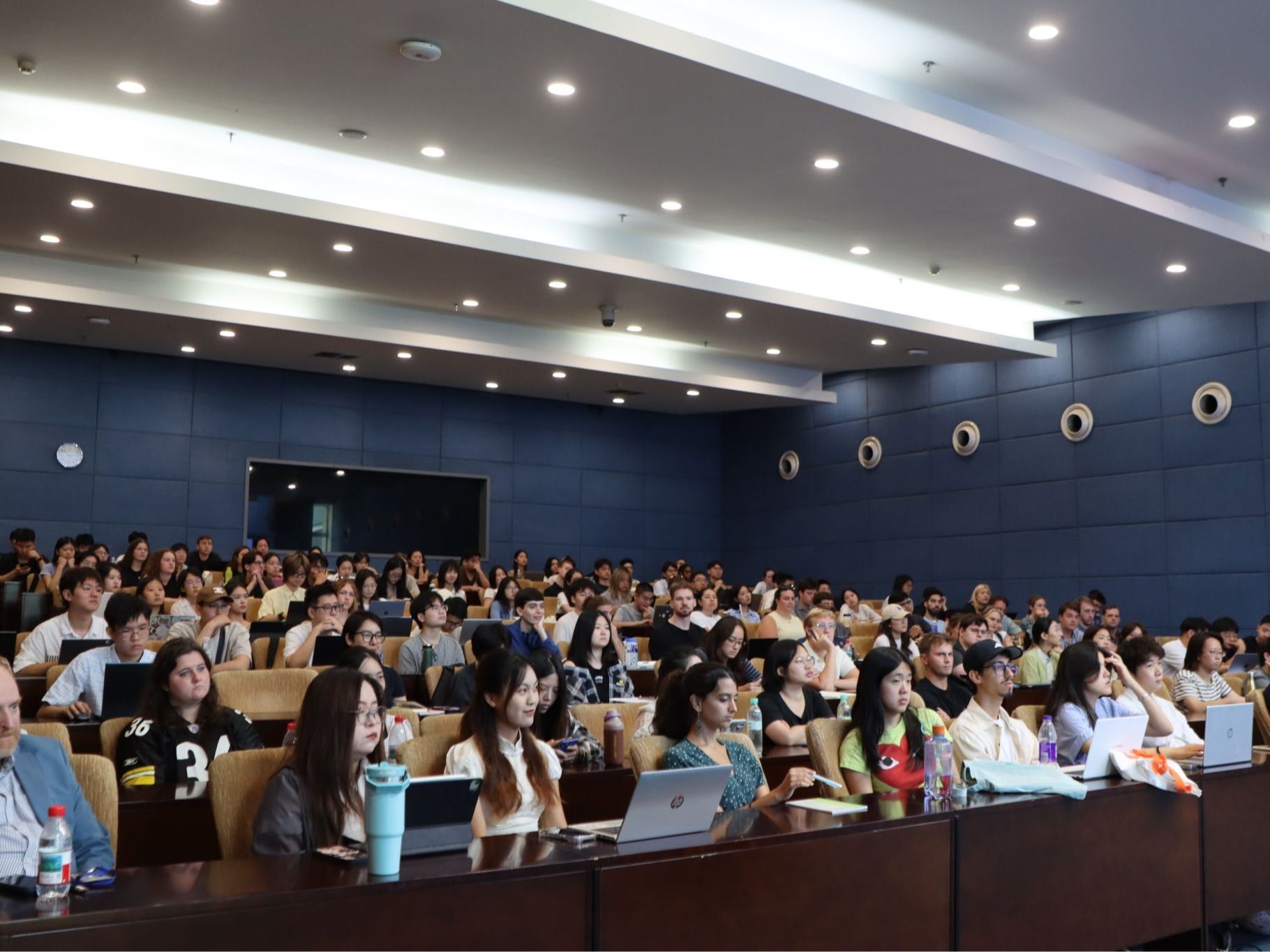
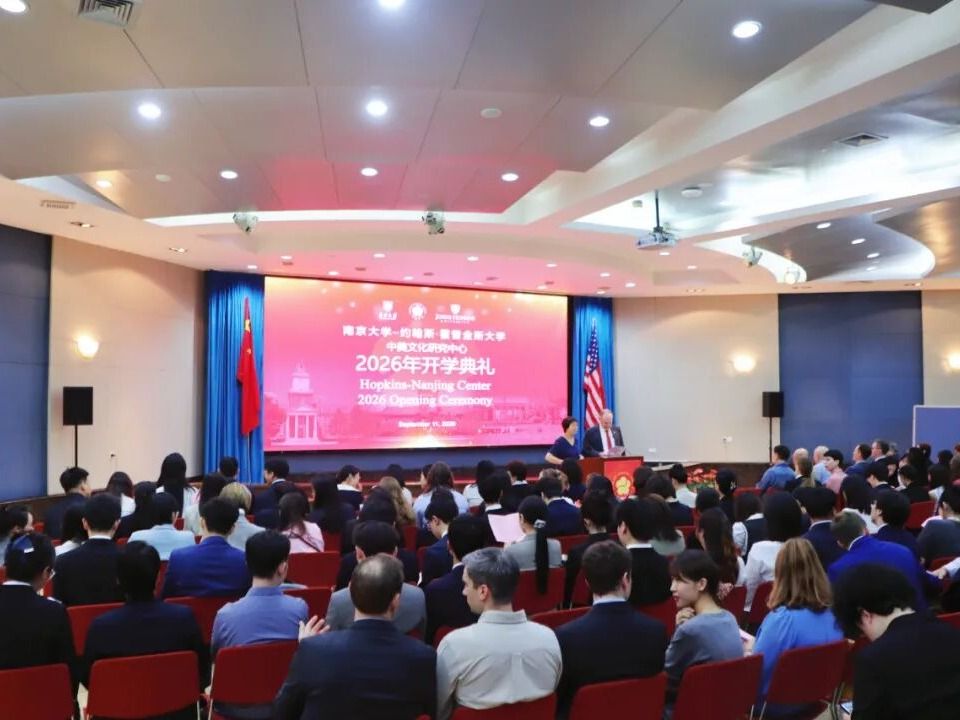
On the morning of June 20, 2026, the Hopkins–Nanjing Center (HNC), jointly established by Nanjing University and Johns Hopkins University, held the inaugural Dr. Chen Tieping Memorial Lecture: A Dialogue Between Chinese and American Scholars at Kuang Yaming Lecture Hall. The event, conducted in both Chinese and English, was an important part of the HNC’s 40th anniversary celebrations.
Attendees included Dr. Peizhen Fan and Dr. Shiguang Fan, Johns Hopkins University alumni and donors who established the Dr. Chen Tieping Memorial Lecture, together with their family members and friends; Ronald J. Daniels, President of Johns Hopkins University; James B. Steinberg, Dean of the Johns Hopkins School of Advanced International Studies (SAIS); Yang Zhong, former Executive Deputy Secretary of the Party Committee of Nanjing University and Executive Dean of the Yangtze Industrial Development Institute; Feng Fan, Director of Alumni Affairs and Development at Nanjing University and Secretary-General of the Nanjing University Education Development Foundation; Li Xiaorong, Chinese Co-Director of the HNC; and Adam K. Webb, American Co-Director of the HNC. The event was moderated by Li Xiaorong.

The inaugural Dr. Chen Tieping Memorial Lecture
At the launch ceremony, Feng Fan presented Dr. Peizhen Fan and Dr. Shiguang Fan with certificates of appreciation and commemorative gifts. Ronald J. Daniels, James B. Steinberg, Dr. Peizhen Fan, Dr. Shiguang Fan, Feng Fan, Li Xiaorong, and Adam K. Webb jointly launched the Dr. Chen Tieping Memorial Lecture.

Presentation of certificates of appreciation

The launch ceremony
In her remarks, Dr. Peizhen Fan introduced the background and purpose of the Dr. Chen Tieping Memorial Lecture and expressed her deep remembrance of Dr. Chen Tieping, who devoted his life to helping the poor and advancing public health. In his remarks of appreciation, Dr. Shiguang Fan expressed the hope that the donation would contribute to educational exchanges and people-to-people dialogue between China and the United States.

James B. Steinberg delivers his remarks
In his remarks at the launch ceremony, James B. Steinberg first expressed his gratitude to Dr. Peizhen Fan and Dr. Shiguang Fan. He noted that the launch of the Dr. Chen Tieping Memorial Lecture would bring a spirit of humanitarian service and care for others into the HNC’s academic exchanges. He emphasized that over the past 40 years, the HNC had made notable contributions to international educational cooperation, cross-cultural understanding, and the development of internationally minded talent. Its achievements had provided a wealth of experience for cooperation between Nanjing University and Johns Hopkins University, making the Center a successful model of Sino-foreign cooperation in education.
Steinberg expressed his hope that the HNC would continue to bring together scholars from around the world to address the issues of our time, provide a platform for in-depth exchanges among young Chinese and American scholars, and achieve further tangible results in international educational cooperation and people-to-people exchanges.

Johns Hopkins University President Ronald J. Daniels delivers his remarks
In his remarks, President Daniels extended his sincere gratitude to Dr. Peizhen Fan and Dr. Shiguang Fan. He noted that their donation, which carries family memories and a legacy of shared values, reflects a deep commitment to cultural heritage and humanitarian service while bringing a profound human dimension to academic cooperation between China and the United States.
He observed that the current global order faces complex challenges and growing uncertainty. Nevertheless, the HNC’s steady development over the past four decades had strengthened his confidence in the future of international cooperation and academic dialogue. Looking ahead to the next ten years, he expressed his hope that the high-level lecture series organized by the HNC would become an important platform for in-depth exchanges and intellectual engagement among scholars from the two countries, bringing together diverse perspectives and different viewpoints and addressing the challenges of our time with rigor and mutual respect.
The Dr. Chen Tieping Memorial Lecture will run for ten years. It aims to honor Dr. Chen Tieping’s lifelong commitment to helping the poor and advancing public health, support high-level academic events at the HNC, and promote educational cooperation between China and the United States as well as broader international cultural and people-to-people exchanges.
A Dialogue Between Chinese and American Scholars

The dialogue between Chinese and American scholars
Following the launch ceremony, the academic dialogue between Chinese and American scholars began. Experts and scholars from both countries held in-depth discussions on two major emerging issues. Drawing on perspectives from both sides and taking current global trends into account, they sought common ground on key issues and shared insights into changes in the global landscape and the development of cross-cultural education.
The World Order in 2030: Chinese and American Perspectives

Speakers for the first discussion
The first discussion, “The World Order in 2030: Chinese and American Perspectives,” was moderated by Zhu Feng, Dean of the School of International Relations at Nanjing University. The speakers were James B. Steinberg, Dean of SAIS at Johns Hopkins University; Yang Jiemian, Chair of the Academic Advisory Committee and Research Fellow at the Shanghai Institutes for International Studies; and Chen Dongxiao, President of the Shanghai Institutes for International Studies.
During the discussion, the scholars examined emerging trends in the world order in 2030 from multiple perspectives, including politics, economics, international relations, and global governance. Drawing on Chinese and American perspectives, they analyzed key issues such as the evolution of globalization, multilateral cooperation, regional developments, and changes in the international order, while assessing the opportunities and challenges that may shape the future global landscape.
The scholars noted that 2030 would be an important turning point in the ongoing transformation of the global order. Although challenges such as unilateralism and geopolitical conflicts would persist, multilateral cooperation and mutual benefit would remain important trends. As two major global powers, China and the United States have a vital role to play in maintaining global stability and promoting development through constructive engagement, rational communication, and deeper cooperation.
Society, Business, and Cross-Cultural Education in an Era of Globalization

Speakers for the second discussion
The second discussion, “Society, Business, and Cross-Cultural Education in an Era of Globalization,” was moderated by Gao Qianqian, Senior Fellow Emerita at the China Analysis Center of the Asia Society Policy Institute. The speakers were Zheng Yi, President of the American Chamber of Commerce in Shanghai; Xiao Kai, President of East China University of Political Science and Law; and Xue Lan, Dean of Schwarzman College at Tsinghua University.
Focusing on the practical dimensions of globalization, the discussion explored three core areas: social development, business cooperation, and cross-cultural education. Drawing on emerging global trends, the scholars examined how interactions among diverse cultures affect social governance and people's livelihoods, and discussed new opportunities and practical challenges in cross-border business cooperation.
In the area of cross-cultural education, the Chinese and American scholars drew on their experience in higher education and broader trends in international education to explore innovative approaches to cross-cultural learning, talent development models, and curriculum design in the current era. They emphasized that cross-cultural education is a key means of fostering international understanding. As globalization continues to deepen, universities need to improve their international education systems, strengthen practical cross-cultural engagement, and cultivate internationally minded graduates with both professional expertise and strong humanistic values. Such talent will help support the sustainable development of global society and business.

The dialogue forum between Chinese and American scholars
Across four decades, the HNC has carried its founding mission forward from one generation to the next. Looking ahead, the Center will continue to respond to global developments while remaining committed to its core mission of fostering people-to-people exchanges between China and the United States. Through its distinctive lecture series, academic dialogues, and educational programs, the HNC will further deepen high-level international educational cooperation and academic exchange, promote mutual learning between Chinese and American civilizations, encourage scholarly exchange, and strengthen connections among young people. In doing so, it will contribute to a global higher education ecosystem that is more resilient and dynamic.